








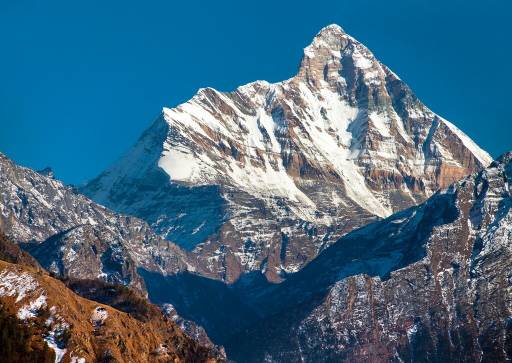
The Nanda Devi National Park, established in 1982, is situated around the peak of Nanda Devi (7816 m) in the state of Uttarakhand.
Located in the mountains of Himalaya in the north, Nanda Devi Biosphere Reserve or Nanda Devi National Park is one of the most expansive bio reserves in India. It was declared a UNESCO World Heritage Site in 1988. It is rich in flora & fauna, hence occupies a significant place on the map of India.
The national park attracts tourists from May to October and remains one of the best places in Uttarakhand to experience natural beauty of mother earth and pleasant weather.
History
The Nanda Devi area was designated as Bioshpere Reserve in 1988 comprising a geographical area of 2,236.74 sq. km., out of which 624.26 sq. km. comprising Nanda Devi National Park was designated as core zone. The area of the Reserve was extended in 2000 to 5,860.69 sq. km. by adding parts of contiguous areas of Valley of Flowers, Malari and Sunderdhunga.
The core zone was also extended to 712.12 sq. km. by including Valley of Flowers National park in the core zone. The Biosphere Reserve was designated to facilitate long term protection of a representative site of Himalayan highlands biogeographic province through conservation, development and logistic support.
The Nanda Devi National Park, established in 1982, is situated around the peak of Nanda Devi (7816 m) in the state of Uttarakhand. The Park was established as Sanjay Gandhi National Park by Notification in 1982 but was later renamed Nanda Devi National Park. Located in the Chamoli district, it encompasses a glacial basin drained by Rishi Ganga and surrounded by snow-capped mighty Himalayan peaks like Nanda Devi, Dunagiri, Maiktoli, Rishi Pahar, Mangaron, and Nanda Khat etc.,
Nanda Devi biosphere is divided into Inner and Outer area. The Inner Sanctuary area comprises of Uttari Rishi glacier and Dakshini Rishi glacier, whereas the outer area consists of basins of Trisul glacier and Ramani glacier. Biosphere Reserve (BR) is an international designation by UNESCO for representative parts of natural and cultural landscapes extending over large area of terrestrial or coastal/ marine ecosystems or a combination thereof.
As of 2021, India has 40 World Heritage Sites. The latest inscriptions in the year 2021 included Kakatiya Rudreshwara (Ramappa) Temple and Dholavira: A Harappan City (Cultural category). As of August 2017, there are 18 Biosphere Reserves in the country. This includes Cold Desert, Himachal Pradesh, Nanda Devi, Uttarakhand, Khangchendzonga, Sikkim, Dehang-Debang, Arunachal Pradesh, Manas, Assam and more.
Major Attraction
One can come to the Park for numerous reasons. However, wildlife experts and enthusiast can find snow leopard present in Nanda Devi National Park, Gangotri National Park and Valley of Flower National Parks. The park is also a major attraction for trekkers and those who enjoy natural beauty.
The Biosphere Reserve includes reserve forests, evam soyam (civil) forests, panchayat (community) forests, agricultural land, grassy slopes, alpine meadows (bugiyals) and snow-covered areas. The alpine vegetation mainly comprises herbaceous species and scrub communities such as Rhododendron campanulatum, R. anthopogon and Salix denticulata. These meadows harbour a large number of rare and endangered, native and endemic species.
It also has some 1,000-plant species including lichens, fungi, bryophytes and pteridophytes have been recorded. The percentage of native and endemic species is high compared to non-native species. Over 55% of the species are native to Himalaya, over 10 are endemic and 225 are near endemic. Among these plant resources, the inhabitants of the Pindari, Lata-Tolma-Malari, and the Valley of Flowers areas use 224 species for various purposes such as medicine, food, and animal fodder.
Seven endangered mammal species find refuge in the area such as the snow leopard (Panthera unica), Himalayan black bear (Selenarctos thibetanus), brown bear (Ursus arctos), musk deer (Moschus chrysogaster) and bharal/blue sheep (Pseudois nayaur).